 information aesthetics.

[from at ]
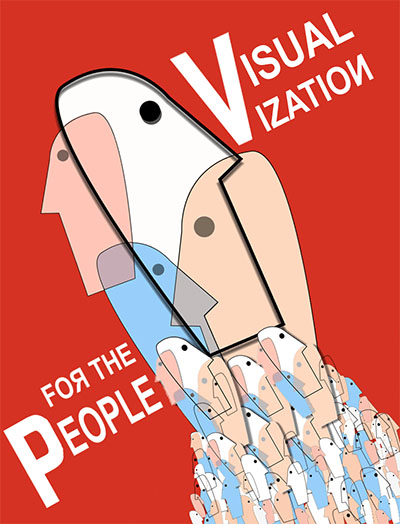
organized a panel entitled “” where he brought together, for the first time, a set of people involved in the emergent field of social data analysis: Ola Rosling, , , & myself.
, , and were all represented and each one of us shared our perspective on what it means to democratize visualization, set data free, and increase data understanding around the world. To me, the power of the ideas put forth by the panelists and the energy we got back from the audience questions made it the best session at InfoVis this year.
A revolution was in the air and you could feel it in the room.
[link: ]
 Published with
  Content protected by
  Designed and Maintained by
  Time and Date follows Time Zone (Brussels)
I believe that in order to truly democratize data visualization, we must make it an engaging experience.
Analysts, designers and researchers who create and manipulate charts do so because they enjoy it. The lay person may not be patient enough to explore and pivot their data to the point they reach insight. They certainly won’t receive the same instant gratification that they’ve gotten from using MySpace or Flickr (by simply seeing their information online).
I agree that, “the best way for real learning to happen” is to allow others to have the same rewarding experience. In addition, the rate at which our community will learn is driven by the rate at which new visualization and analysis tools are adopted. To increase the adoption rate, we must make tools that engage the user, are intuitive to use, and educate users as they provide insight.
Jeff Carpenter
Founder, AgileGraph
I agree with Jeff's view above, and I share Fernanda's excitement about this new movement in visualization ("for the masses"), but my impression from the response to this panel and the "InfoVis for the Masses" panel on Sunday is that the "traditional" infovis community is not entirely on-board with the idea yet.
For me, Ola Rosling and Martin Wattenberg made two of the most poignant observations during this panel discussion. Ola jabbed at the absurdity of the infovis community being defensive about “freeing” infovis: he made a playfully sarcastic analogy to professional photographers being upset that the field of photography has been compromised by the fact that almost everyone in the world is taking photographs with their cellphones now. Martin emphasized the value of “vernacular visualization,” and the idea that non-experts (in the traditional sense) are producing and consuming very effective visualizations whose design does not necessarily reflect the most valued principles of traditional infovis (“the data above all else?”).
I would argue, as Fernanda suggested in her presentation, that visualization needs to be understood as a medium for communication, with all the subtlety that such an understanding entails, rather than being held up as some kind of untouchable, impartial herald of “truth.”
I agree with the concept of letting people make their own mistakes when it comes to setting data free.
My feeling is that this very much ties into issues of visual literacy, and 'pictoriacy' - that, slowly, but surely, people will learn the 'language of visualisation' as we have learnt the 'language of the web', for instance.
In line with Mike's comment about 'traditional' infovis, I hope that it's not such a big issue, because traditional infovis is more attune with experts - and the techniques used reflect that. Vis for the masses does/will/should take a slightly different approach, which the Matt Ericson's InfoVis keynote addressed perfectly!
To me this movement ought to be primarily about being able to create knowledge from all that available data. Visualizations are simply, but significantly, a great vehicle to do that.
Someone needs to step up and create a standard which encompasses storing numerical data and being able to visualize it. A standard will ensure that that innovation is shared and will allow the entire community to participate, evangelize and rally behind this cause in a manner which ensures a natural evolution to some success.
An online application which allows people to extract data and store it in a universally known and usable format could create an open, decentralized and central repository. A standard which allows third party developers to participate and build visualization will create a thriving development community by allowing them to express themselves.
Imagine a 3d chart that is really 3d, interactive, and can be viewed simultaneously by multiple people... and they can all see what the others are looking at... this is what you get when you visualize data within Second Life.