 information aesthetics.

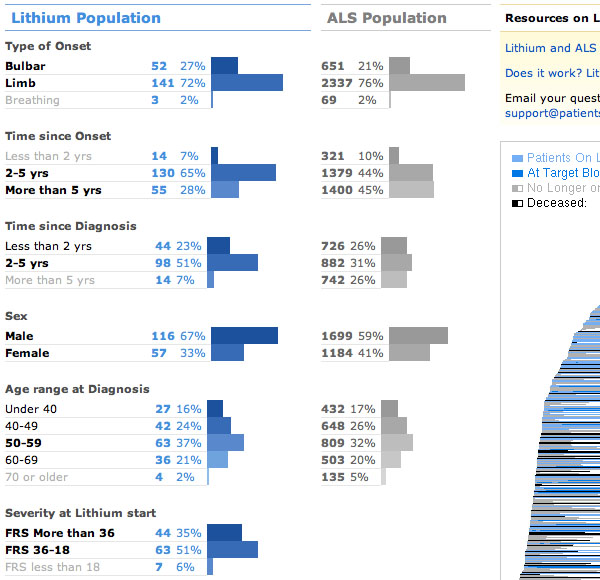
[patientslikeme.com] seems like the most useful example of the combination of sophisticated data visualization and online social media. It demonstrates the power of the social aggregation of data, and the tilting equilibrium between privacy and value creation for people who crave to access valuable information about their own faith.
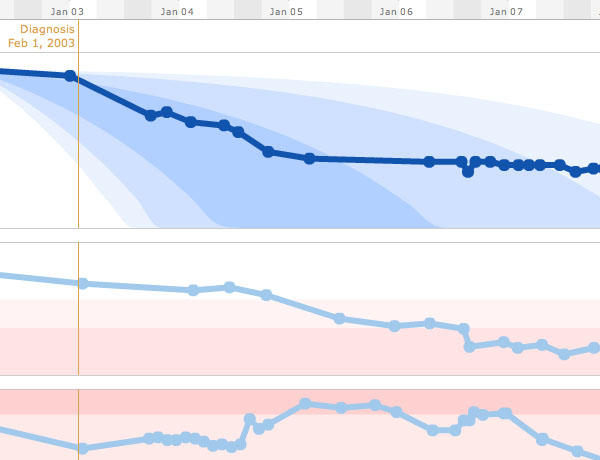
The first, almost obvious, feature allows people with a life-changing disease (e.g. ALS, HIV, Parkinson's, Chronic Fatigue Syndrome, MS) to connect to others in the same situation, for instance to learn how they treat their disease or to compare one's own health progress with those of others. Even more, by sharing their own health profile, patients are empowered to exchange valuable data about the real-world effects of specific medical treatments. In practice, this means anyone can explore a rich collection of crowd-sourced data about individual diseases, symptoms or treatments.
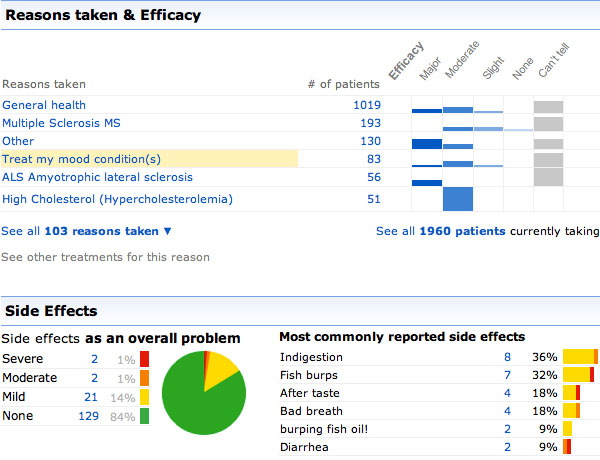
For instance, patients are able to explore the efficacy, side effects, adherence and burden of the "" treatment meant to remedy disease, or investigate the , solely based on the quantitative and qualitative input of thousands of individuals.
In what seems a quite revolutionary take on medical privacy, the diseases, treatments and symptoms of can be filtered, searched and compared. Alternatively, people with a specific symptom, let's say "fatigued", can investigate the effectiveness of the most popular or compare their faith with the other that experience this very symptom.
See also Who is Sick Map, Google Flu Trends, CureHunter, Diseasome, Visualizing Health Issues, The Cost of Getting Sick and Epidemiological Diseases Map.
 Published with
  Content protected by
  Designed and Maintained by
  Time and Date follows Time Zone (Brussels)