 information aesthetics.
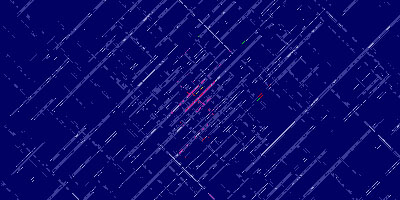
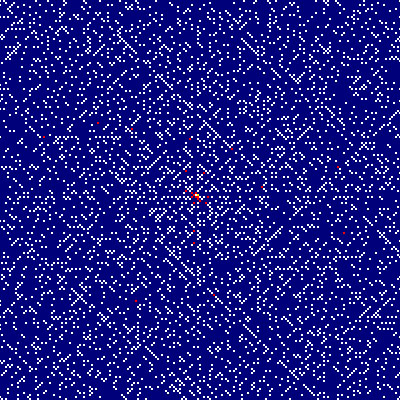
a simple line & dot plot, invented by Polish-American mathematician Stanislaw Ulam, in which the positive integers are arranged in a spiral with the prime numbers highlighted in some way along the spiral. non-random patterns of diagonal lines become unexpectedly apparent.
see also number spiral.
[links: & ]
 Published with
  Content protected by
  Designed and Maintained by
  Time and Date follows Time Zone (Brussels)
So ... how does this work, exactly?
It could be an artifact of the human brain/visual perception. First test would be to see if diagonal lines appear when plotted with random numbers. Our brains are trained to pickup subtle patterns from noise, maybe we pick this up because evolutionarity in nature prime patterns occur in more "valuable" and "interesting" objects. Another good experiment would be determining if monkey/dogs/rats can distinguish this vs. a random pattern, and give reward accordingly.
It could be an artifact of the human brain/visual perception. First test would be to see if diagonal lines appear when plotted with random numbers. Our brains are trained to pickup subtle patterns from noise, maybe we pick this up because evolutionarity in nature prime patterns occur in more "valuable" and "interesting" objects. Another good experiment would be determining if monkey/dogs/rats can distinguish this vs. a random pattern, and give reward accordingly.
No, it's not just a brain pattern. You can search for functions (Euler one, for example) where one of that diagonal's match. It isn't a perception issue. I can provide links and maybe some pdf's about both subjects, just ask sending an e-mail to with the location you read this message. Thanks.
Dogs for sale gives the information on different typers of dogs which are on sale. The dogs are available in different ranges from medium to long on consideration of hair with a dense undercoat. Dog breeders information is also available.