 information aesthetics.
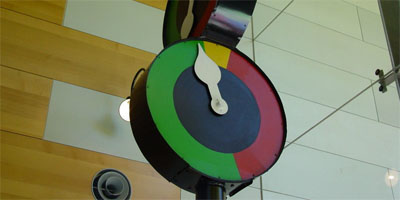
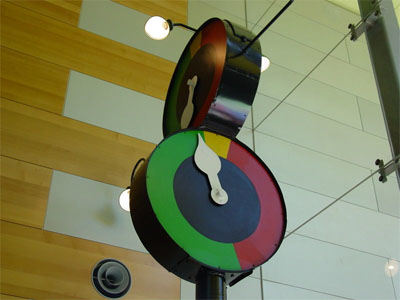
an alternative, rotary traffic signal designed by Charles Marshall in 1936 & used from the 1940s through 1970s in Australia. 2 rotors pointing at colored sections denote whether traffic in either direction should proceed, prepare, or stop. based on a traditional clock face, it has the advantage of clearly showing signal phase timing.
[link: |thnkx Peter]
 Published with
  Content protected by
  Designed and Maintained by
  Time and Date follows Time Zone (Brussels)
Might the extra information about the cycle lead to potential abuse? The extra information allows one to more accurately judge the timing of the transitions; one might be more likely to run an early yellow, or a late red.
The ambiguity of the exact moment of state transition in "boolean" traffic lights may discourage such such corner-cutting.
I remember seeing these on a childhood trip to either Adelaide or Melbourne in the '60s. AFAICR they were in use in parallel with conventional traffic lights. I always assumed that they were being used to indicate a new phasing arrangement.
They do have the disadvange of not being able to support dynamic phasing.
neat,
yes there seems to be a danger of abuse, but it reminds me of the pedestrian way countdowns in the netherlands, deHague I think.
I wonder if there is a danger documented. People might cut corners, but at the same time, traffic could flow better, as people could prepare better for the 'green' phase
Around here, the lights are timed such that the the "don't walk" light flashes 12 times, then goes solid for .5 seconds before your traffic light changes(to tell when not only when the light is going green, but if you watch the parallel ones, when it's going red). At some intersections you can see them flash from quite a distance. Also, the left turn lights crossing your direction wait 8 seconds after the last car crosses the inductive sensor before your light changes.
Drive safely, pay attention...
The amber and green are not really necessary, one red signal will do, this can pulse before going off, i.e. to the 'green', 'go' state. A fair amount of 'leccy' would be saved with the red-only system.
Only trouble with a red-only system is that there's no way to distinguish between a 'go' signal and a broken signal - generally speaking, it's preferrable to design things so that they fail into the safest configuration.
Too late. Here in Miami there are countdown timers on the crosswalks and you can clearly see how much time you got before light turns yellow. Not exactly the same but effective nonetheless.
I would worry about the transitions. From any kind of distance there could be some disagreement as to whether or not the the pointer was on the red or the green when it was moving between the two. Lots of wrecks with this system.
Traffic Lights with Digital Displays?
Possible Solution: Longer Lag Between Red and Green.
That could reduce possible collisions between red light runners and green light riders.
The ambiguity of the exact moment of state transition in "boolean" traffic lights may discourage such such corner-cutting... Oyunxx..
Leah is definitely the one who should win. Science Fiction Conventions? What?! She deserves a win, indeed!
I'm guessing the only way to do this in Javascript would be to use the onresize event, and then using the resizeTo method to attempt to keep the window at the size you want?
For those of you thinking that if they implement this it will eliminate some of the waiting and lines…
Too late. Here in Miami there are countdown timers on the crosswalks and you can clearly see how much time you got before light turns yellow. Not exactly the same but effective nonetheless.
From any kind of distance there could be some disagreement as to whether or not the the pointer was on the red or the green when it was moving between the two. Lots of wrecks with this system.
Thankss
agree with plastik , She deserves a win !
I would worry about the transitions. From any kind of distance there could be some disagreement as to whether or not the the pointer was on the red or the green when it was moving between the two. Lots of wrecks with this system.
I hope the petty little group that tried to stifle free speech with said spurious DMCAs gets their ass handed to them. I would say this even if it was the creationists who were being picked on through illegal means, really - free speech is free speech!
Ironically, I've never heard of that anti-creationism group before, and what'll probably happen here is it'll backfire on the creationist group, creating more publicity for people they perceive to be a threat - thus ensuring that more people will check the other group out, and MAKING them more of a threat. Not to mention the legal trouble the creationist group is liable to get into over this.
For me it worked one time only. Next day i tried it again and no star appeared, just one curved line. Possibly because of some other magnets i have at home near this starmaker, it interferes somehow, but Lancome does not tell you to keep it away from other magnets, so be careful with this tiny bootle...
ı wonder if there is a danger documented. People might cut corners, but at the same time, traffic could flow better, as people could prepare better for the 'green' phase
Fri 30 May 2008 at 10:01 PM
Marcus Kirsch
From any kind of distance there could be some disagreement as to whether or not the the pointer was on the red or the green when it was moving between the two. Lots of wrecks with this system.
For those of you thinking that if they implement this it will eliminate some of the waiting and lines…
Traffic Lights with Digital Displays?
Possible Solution: Longer Lag Between Red and Green.
That could reduce possible collisions between red light runners and green light riders.
Only trouble with a red-only system is that there's no way to distinguish between a 'go' signal and a broken signal - generally speaking, it's preferrable to design things so that they fail into the safest configuration.
Leah is definitely the one who should win. Science Fiction Conventions? What?! She deserves a win, indeed!
Too late. Here in Miami there are countdown timers on the crosswalks and you can clearly see how much time you got before light turns yellow. Not exactly the same but effective nonetheless. thanks
Around here, the lights are timed such that the the "don't walk" light flashes 12 times, then goes solid for .5 seconds before your traffic light changes(to tell when not only when the light is going green,
From any kind of distance there could be some disagreement as to whether or not the the pointer was on the red or the green when it was moving between the two. Lots of wrecks with this system.
Thankss
The ambiguity of the exact moment of state transition in "boolean" traffic lights may discourage such such corner-cutting.
Might the extra information about the cycle lead to potential abuse? The extra information allows one to more accurately judge the timing of the transitions; one might be more likely to run an early yellow, or a late red.
I think it can be used only as addition to normal traffic light system because of danger of abuse.
Around here, the lights are timed such that the the "don't walk" light flashes 12 times, then goes solid for .
Might the extra information about the cycle lead to potential abuse? The extra information allows thank you
From any kind of distance there could be some disagreement as to whether or not the the pointer was on the red or the green when it was moving between the two. Lots of wrecks with this system.
For those of you thinking that if they implement this it will eliminate some of the waiting and lines… I Think
Very interesting informations. I come back for more informations and I have added this pageto my favourites. Thanx for the authors great work.
Greetings from Russia
Alla
Hi,
Very nice themes for personal blog, i’ll add this theme to my theme list.
Thank you,
on the red or the green when it was moving between the two. Lots of wrecks with this system.
For those of you thinking that if they implement this it will eliminate some of the waiting and lines
Very nice themes for personal blog, i’ll add this theme to my theme list.
Thank you,
I am trying to find one of the original Marshalite rotary traffic signals – I'd love to buy one. I lived for many years in Mt Eliza, Victoria and travelled along the Nepean Highway between Mordialloc and Seaford where these traffic lights were installed until the late 1970s. Can anyone help me find one?
The ambiguity of the exact moment of state transition in "boolean" traffic lights may discourage such such corner-cutting
Might the extra information about the cycle lead to potential abuse? The extra information allows one to more accurately judge the timing of the transitions; one might be more likely to run an early yellow, or a late red.
I am trying to find one of the original Marshalite rotary traffic signals – I'd love to buy one. I lived for many years in Mt Eliza, Victoria and travelled along the Nepean Highway between Mordialloc and Seaford where these traffic lights were installed until the late 1970s. Can anyone help me find one?
I would worry about the transitions. From any kind of distance there could be some disagreement as to whether or not the the pointer was on the red or the green when it was moving between the two. Lots of wrecks with this system.
Might the extra information about the cycle lead to potential abuse? The extra information allows one to more accurately judge the timing of the transitions; one might be more likely to run an early yellow, or a late red.
late
Around here, the lights are timed such that the the "don't walk" light flashes 12 times, then goes solid for .
From any kind of distance there could be some disagreement as to whether or not the the pointer was on the red or the green when it was moving between the two. Lots of wrecks with this system.
thanks you
Might the extra information about the cycle lead to potential abuse? The extra information allows one to more accurately judge the timing of the transitions; one might be more likely to run an early yellow, or a late red.
I would worry about the transitions. From any kind of distance there could be some disagreement as to whether or not the the pointer was on the red or the green when it was moving between the two. Lots of wrecks with this system.
Around here, the lights are timed such that the the "don't walk" light flashes 12 times, then goes solid for .
thank you I would worry about the transitions. From any kind of distance there could be some disagreement as to whether or not the the pointer was on the red or the green when it was moving between the two. Lots of wrecks with this system.
I remember seeing these on a childhood trip to either Adelaide or Melbourne in the '60s. Thanks.
I remember seeing these on a childhood trip to either Adelaide or Melbourne in the '60s. AFAICR they were in use in parallel with conventional traffic lights. I always assumed that they were being used to indicate a new phasing arrangement.
I would worry about the transitions. From any kind of distance there could be some disagreement as to whether or not the the pointer was on the red or the green when it was moving between the two. Lots of wrecks with this system.
thank you I would worry about the transitions. From any kind of distance there could be some disagreement as to whether or not the the pointer was on the red or the green when it was moving between the two. Lots of wrecks with this system.
this is very nice blog,thank you for all
Hi, I just thought i'd post and let you know your web site layout is really messed up on the Firefox browser. Seems to work ok on IE however. Anyhow keep up the great work.
WOW! that video just blew my mind. like staring at television static. beautiful!!
Thanks, Around here, the lights are timed such that the the "don't walk" light flashes 12 times, then goes solid for .
I like this…
Something different and a nice option
that can be used for all browsers and look the same.
Well done. I will definitely have to use something like this.
The ambiguity of the exact moment of state transition in "boolean" traffic lights may discourage such such corner-cutting.
Around here, the lights are timed such that the the "don't walk" light flashes 12 times, then goes solid for .5 seconds before your traffic light changes(to tell when not only when the light is going green, but if you watch the parallel ones, when it's going red). At some intersections you can see them flash from quite a distance. Also, the left turn lights crossing your direction wait 8 seconds after the last car crosses the inductive sensor before your light changes.
Drive safely, pay attention...
I would worry about the transitions. From any kind of distance there could be some disagreement as to whether or not the the pointer was on the red or the green when it was moving between the two. Lots of wrecks with this system.
From any kind of distance there could be some disagreement as to whether or not the the pointer was on the red or the green when it was moving between the two. Lots of wrecks with this system.
The ambiguity of the exact moment of state transition in "boolean" traffic lights may discourage such such corner-cutting
Thanks a lot for the wonderful information
Thanks a lot for the wonderful information
I'm guessing the only way to do this in Javascript would be to use the onresize event, and then using the resizeTo method to attempt to keep the window at the size you want?
I'm guessing the only way to do this in Javascript would be to use the onresize event, and then using the resizeTo method to attempt to keep the window at the size you want
I'm guessing the only way to do this in Javascript would be to use the onresize event, and then using the resizeTo method to attempt to keep the window at the size you want?
I remember seeing these on a childhood trip to either Adelaide or Melbourne in the '60s. Thanks.
I'm guessing the only way to do this in Javascript would be to use the onresize event, and then using the resizeTo method to attempt to keep the window at the size you want?
I cannot ponder your highly effective here is make only took 2D pix and additionally transfered the criminals to the three-dimensionally version. Which has conducted previously. Your intersting matter is they procured all of them because of Sparkle information coupled with earned free a real-time a model in 3d condition belonging to the overall metropolis.
I remember seeing these on a childhood trip to either Adelaide or Melbourne in the '60s. AFAICR they were in use in parallel with conventional traffic lights. I always assumed that they were being used to indicate a new phasing arrangement.
They do have the disadvange of not being able to support dynamic phasing.
Never so this before. This is great for showing my little one how is traffic signalization works.
Hi - very good web site you have established. I enjoyed reading this posting. I did want to issue a comment to tell you that the design of this site is very aesthetically pleasing. I used to be a graphic designer, now I am a copy editor in chief for a marketing firm. I have always enjoyed playing with information processing systems and am attempting to learn code in my spare time (which there is never enough of lol).
I remember seeing these on a childhood trip to either Adelaide or Melbourne in the '60s. AFAICR they were in use in parallel with conventional traffic lights. I always assumed that they were being used to indicate a new phasing arrangement.
They do have the disadvange of not being able to support dynamic phasing.